
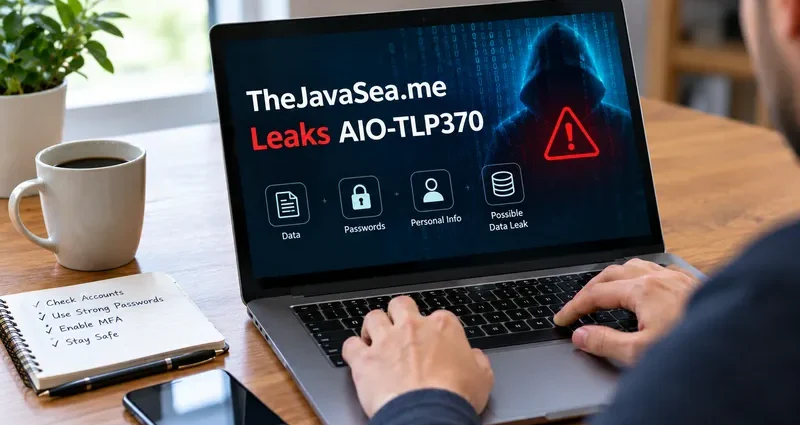
Searches for thejavasea.me leaks aio-tlp370 can be confusing because different websites describe the term in different ways. Some pages call it a leak package, while others describe it as a bundled archive or an online identifier.
The important point is that the name itself does not prove what the material contains, where it came from, or whether it represents a newly confirmed data breach. Current public coverage provides enough evidence to discuss the term, but not enough to treat every claim about its contents or scale as established fact.
This guide explains what the keyword appears to represent, why the terminology can be misleading, and what users can do without opening or downloading questionable files.
What Is TheJavaSea.me Leaks AIO-TLP370?
TheJavaSea.me leaks aio-tlp370 appears to be a search phrase connecting the TheJavaSea.me domain with an identifier called AIO-TLP370.
Based on current public discussions, AIO-TLP370 is better described as an unverified leak-related identifier than as the official name of a confirmed security incident.
That distinction is important. A filename, forum label, screenshot, or repeated blog claim cannot by itself establish that a particular company was breached or that a specific number of records were exposed.
A properly verified incident normally has stronger evidence, such as an affected organization’s statement, technical investigation, regulatory disclosure, or independently validated information showing where the exposed material originated.
What Does AIO-TLP370 Mean?
The identifier can be divided into several parts, but their exact meaning has not been officially established.
AIO
In technology terminology, AIO commonly means “All-In-One.” It can describe a bundle containing multiple resources, files, tools, or datasets.
However, that common abbreviation does not prove that “AIO” has exactly that meaning in this particular identifier. Without an authenticated description or original documentation, it is better treated as a reasonable interpretation rather than a confirmed definition.
TLP
The letters TLP create another source of confusion.
In cybersecurity, TLP officially refers to the Traffic Light Protocol, maintained by FIRST. Its current standard uses four recognized labels: TLP, TLP, TLP, and TLP.
AIO-TLP370 is not one of those official classifications.
Therefore, the “TLP370” portion should not be presented as a cybersecurity sensitivity level or an official FIRST designation. It may simply be an informal package, post, sequence, or release identifier.
The Number 370
There is no reliable public documentation establishing what “370” specifically represents. It could be an internal sequence or package number, but assigning a precise meaning without evidence would be speculation.
Is AIO-TLP370 a Confirmed Data Breach?
At the time of this research, available public evidence does not establish AIO-TLP370 as one independently verified new data breach.
This does not prove that every associated claim is false. It means readers should separate online discussion from verified evidence.
For example, an article might state that a package contains passwords, source code, private documents, API keys, or other sensitive material. Unless the claim can be traced to a credible original source or technical investigation, it should remain an allegation rather than a fact.
This is especially important with thejavasea.me leaks aio-tlp370, because several pages repeat similar descriptions without providing independent evidence for the origin, age, authenticity, or size of the alleged material.
Why Repeated Online Claims Can Be Misleading
Search engines can make a claim appear established simply because many pages repeat it.
Imagine that one article publishes an unverified statement. Ten other websites then summarize that article. A later page may cite those ten pages and conclude that the information is “widely reported.”
That still does not create ten independent confirmations.
For leak-related topics, useful questions include:
- Who originally made the claim?
- Is the source identifiable?
- Is an affected organization named?
- Is there technical evidence?
- Can the age of the data be established?
- Has the information been independently examined?
- Are different websites actually providing new evidence?
If the answer to most of these questions is no, the claim deserves cautious treatment.
Could the Material Be Old or Repackaged?
Yes, that is one possibility that should be considered when evaluating an alleged digital leak.
An online archive can potentially contain older information, duplicated records, material collected from different sources, or information that was already publicly circulating.
A new filename or recently published article does not automatically prove that the underlying information was obtained recently.
This matters because people sometimes interpret the appearance of a new package as evidence of a new attack. Without a documented timeline and source analysis, that conclusion cannot safely be made.
What Should You Do If You Are Worried?
You do not need to locate or download an alleged leak to determine whether your accounts may be exposed.
1. Check Your Email Safely
A reputable breach-notification service such as Have I Been Pwned can show whether an email address appears in known breach datasets.
Importantly, a clean result does not prove that an account has never been exposed. It means the address was not found in the datasets available to that service.
Never enter your current password into an unfamiliar “leak checker.”
2. Change Reused Passwords
If you have used the same password on several websites, change it on each important account.
Your primary email deserves special attention because access to it can allow password resets for other services.
Using a password manager can make it easier to create and maintain unique passwords.
3. Enable Multi-Factor Authentication
Turn on MFA for email, financial services, cloud accounts, social platforms, and other important services whenever available.
MFA adds another authentication requirement beyond the password, reducing the usefulness of a stolen password by itself.
4. Review Account Sessions
Check your account’s security dashboard for:
- Unknown devices
- Unrecognized login locations
- New recovery methods
- Suspicious connected applications
- Unexpected password changes
- Unfamiliar email forwarding rules
Remove access that you do not recognize and follow the provider’s official recovery process if necessary.
What If You Downloaded a Suspicious File?
If you downloaded a file associated with a leak-related page, do not open it simply to see what is inside.
Unknown archives may contain malicious software, deceptive files, or unauthorized personal material.
If you already opened or executed something suspicious, update your operating system and security software, run a reputable security scan, and secure important accounts from a separate trusted device if necessary.
For a company-owned computer, contact the organization’s IT or security team rather than experimenting with the file yourself.
How to Judge Future Claims About AIO-TLP370
When a new article appears, look beyond its headline.
A stronger source should provide identifiable evidence rather than simply repeating phrases such as “massive leak,” “millions of records,” or “confirmed database.”
Look for:
- An identifiable affected organization
- A credible original source
- A documented incident timeline
- Technical evidence or independent analysis
- Clear information about what was actually exposed
- Separation between verified facts and assumptions
This approach is more reliable than counting how many websites mention the keyword.
Is TLP370 an Official Cybersecurity Classification?
No. The official Traffic Light Protocol maintained by FIRST recognizes TLP, TLP, TLP, and TLP.
Therefore, readers should not interpret “TLP370” as an official security classification simply because the letters TLP appear in the name.
The similarity is more likely to create confusion than provide evidence about the alleged material.
Final Takeaway
TheJavaSea.me leaks AIO-TLP370 is best treated as an unverified leak-related identifier rather than automatically calling it a confirmed data breach.
The biggest problem surrounding the keyword is not simply determining what the label means. It is separating information that can be verified from descriptions that have been repeatedly copied across the web.
Users do not need to visit a leak source, download an archive, or handle allegedly stolen information to protect themselves. Checking known breach exposure through reputable services, using unique passwords, enabling MFA, reviewing account activity, and staying alert to phishing provides a safer response. For more information, visit our website.